

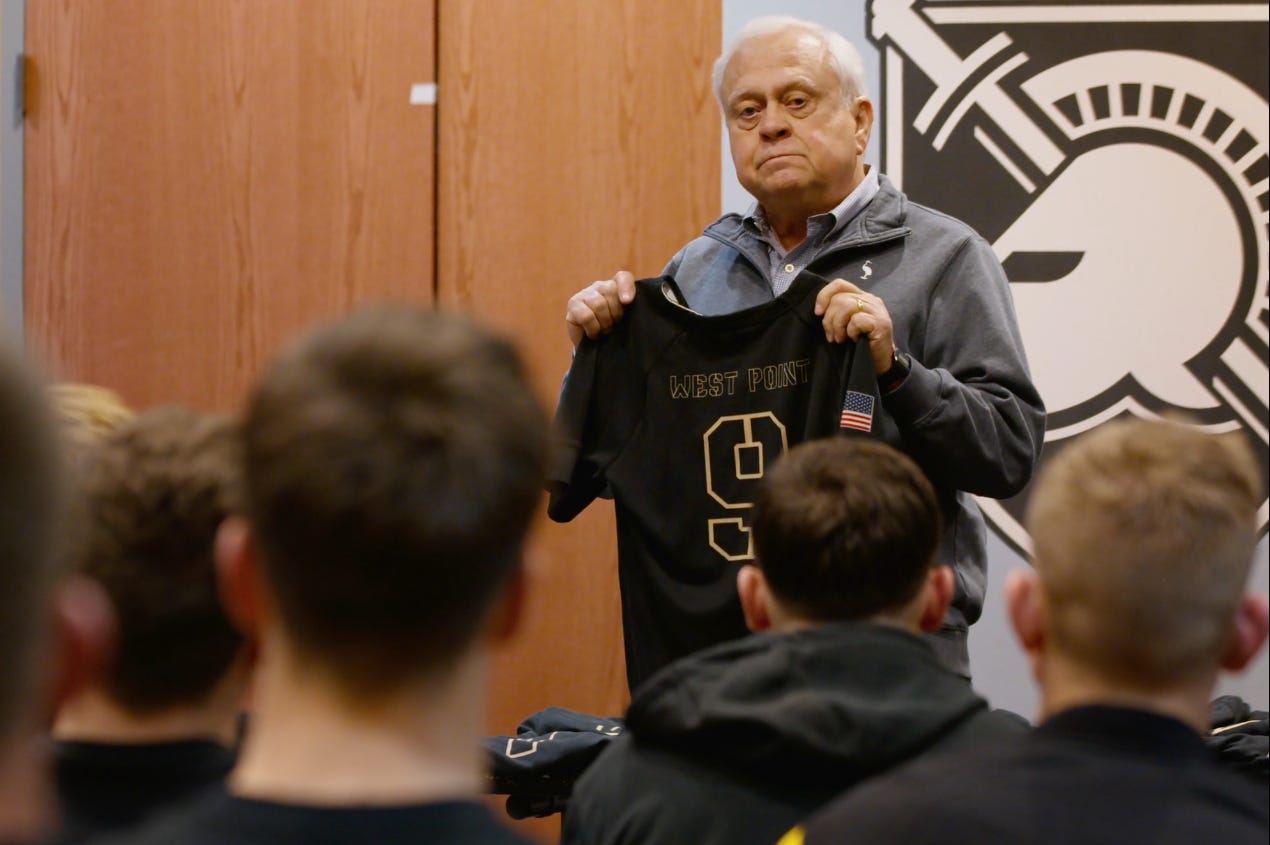
“I’m not sure it’s really a career. It’s more like a passion, I guess. It’s a career that I didn’t get paid for” — Mike Mahan on coaching rugby at West Point, Jan. 7 2021
On Friday, at the U.S. Military Academy in New York state, graduates and supporters of Army Rugby will gather. After dinner, they’ll see Brothers on Three, the new documentary about the team by Sean Mullin, West Point full-back turned director and producer.
On Saturday, before Army v Navy at Anderson Rugby Complex, down on the banks of the Hudson, the Old Gray will unveil a bust of the man to whom the weekend, like Mullin’s film, is dedicated: Mike Mahan, the great coach who died last year.
I’ll be there too. As most readers will know, I played against Mahan’s team in the U.K. in 2002, years later set out to find out what happened to them in the wars after 9/11, then eventually wrote a book, Brotherhood: When West Point Rugby Went To War. Most have probably heard enough about West Point from me. But then, they assuredly haven’t read enough about Mike Mahan. There’s a reason his Army players called him “Father”. Without him, and his 16 seasons of hard work, Army Rugby might never have grown into what it is today.
Fittingly, it was Mike who introduced me to rugby at West Point. When I first went up the Hudson, in May 2015, he was about to retire for the second and final time. Welcoming me into his office, he put a picture out on his desk: 13 young men, in kilts or carrying sabers or rugby balls, posed self-consciously, printed in knowing sepia, looking into the history they’d make. Gently, Mike told me three of the players were dead. I knew I had a story to write.
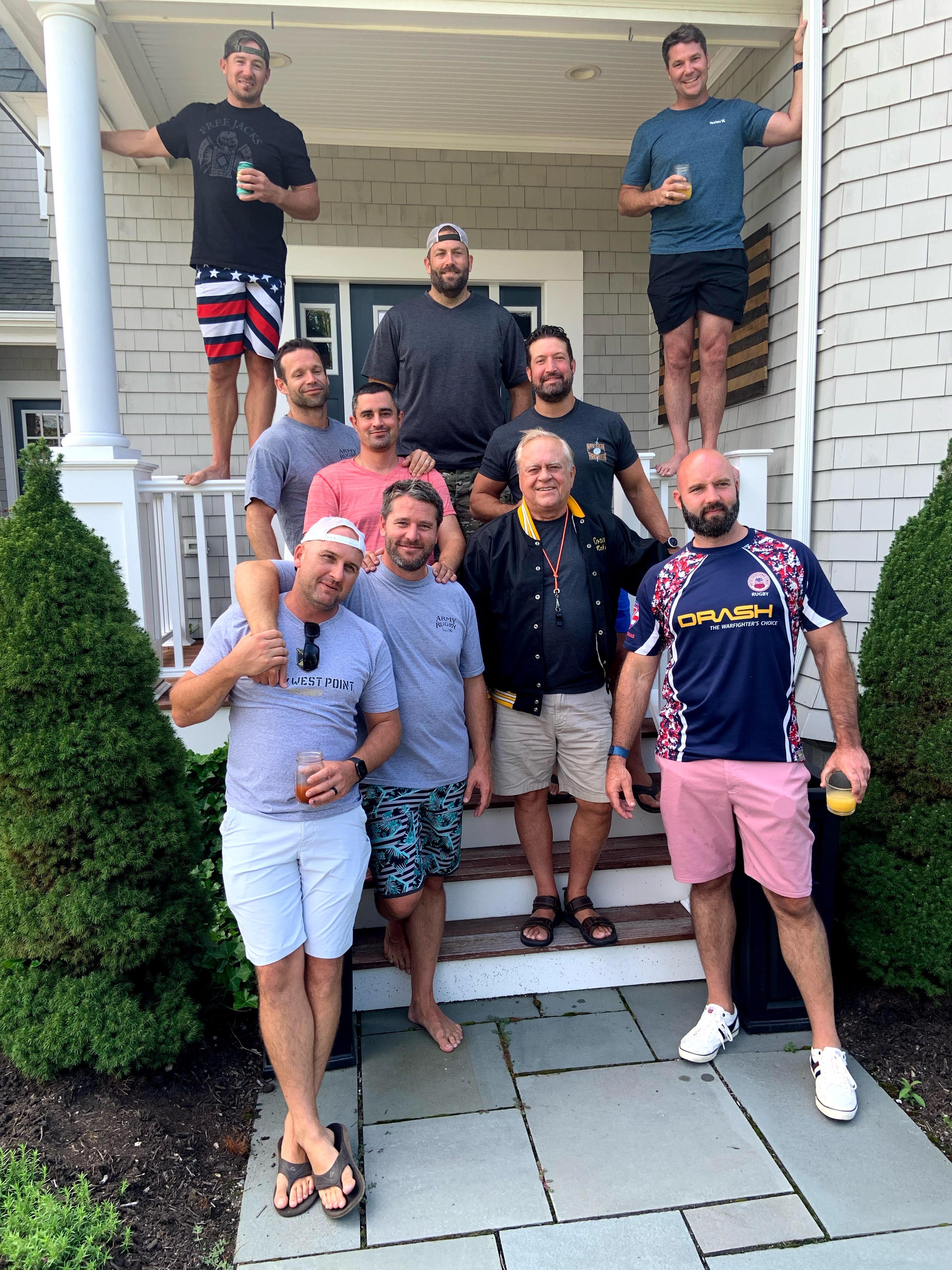
Years later, for the book, I made sure Mike was my first interviewee. As with every conversation for Brotherhood — just as Sean filmed hundreds of hours of footage for Brothers on Three and cut it all down to an hour 40 — only a fraction of my conversation with Mike made it into my finished 400 pages. Nor was that first conversation the only one we had as I wrote. We talked repeatedly, including at a memorable team reunion in Massachusetts in summer 2021.
This week, I went back into my Brotherhood archive, to find that first conversation with Mike confirmed something rather surprising. In my review of Brothers on Three for the Guardian, I wrote that Mike never played rugby, despite coming to coach it for so long and to such lasting effect and regard. I’d thought that for 10 years. Small problem: I was wrong. Somewhere between transcript and manuscript, a quote — “I learned how to play rugby when I was out in the army, living in California” — became a paraphrase — “He hadn’t known rugby at West Point but he came across a game or two during a posting to California” — and thus a lasting misconception was born, if only in my head, finally to come out in print in a distinctly embarrassing way.
Writing is full of such pitfalls. Thanks, therefore, to Pete Patacsil and Al Hogue of the Old Gray, who sent details and photographic evidence of Coach Mahan’s playing career, at prop forward for Monterey Bay Rebels (1976-78), MIT (1978-80, Club President), and the Old Gray (1980-83).
So it goes. On to my 2021 interview with Mike. As they say in the press, it has been edited for clarity and length. It’s still quite long, but it’s mostly Mike talking and me listening, as it evidently should be.
MP: So – tell me how you came to coach rugby at West Point:
MM: OK, I’m going to go back a little bit, to give you a good understanding of really what Army Rugby was during my tenure. And this goes way back.
When I went to West Point was in the late 60s. And I went because I had a couple of examples of leaders that I experienced in high school. Both of them were coaches. And I got really intrigued about learning more about leadership. So I had planned to try to do pre-med and had a scholarship, had registered, all of that stuff, and then I sort of changed my course and went to West Point.
When I got there, I found out that there was nothing but institutionalized harassment. It was sort of, if you could survive the four years, you’re the type of person who we want to be in our military. It was no leadership. And in fact, it was negative leadership. So I got really down on serving. I had two little statues — they let you keep two things on your desk at West Point. One was a little statue of a special operations soldier and the other one was a coffee cup that said ‘Out and alive in 75,’ being that I would graduate in 1970 and I had a five-year commitment.
I graduated and took an assignment in the infantry in Germany. And it turned the whole thing around for me: the experience of being a platoon leader was so exhilarating and exciting, and it was everything I had dreamed about as as being a leader. So I pursued that. I did very well. And I had an opportunity to go back to West Point, to be on the staff and faculty as a young captain, where we’re talking now 1980.
And I hadn’t learned to play, I didn’t even know the sport of rugby existed, when I was at West Point. It was not a mainline sport. I don’t know if everybody knows about rugby now. I think it’s the most winning sport on West Point — anybody will tell you, whether it’s true or not.
But I learned how to play rugby when I was out in the army, living in California. So when I was in grad school — they send you back to grad school for two years before you go back to West Point to teach — I was finishing up two years at MIT. And I found out that West Point had a match against Harvard Business School, locally. So I went to watch the match. And I mentioned to one of the coaches, Major Bill Foster, who is an absolutely great individual, that I was coming to teach at West Point in the fall. And when I got my desk that summer at West Point, the first call I got was from Bill, who said, ‘You need to come help us coach.’ And so that’s how I got involved.
I went back to West Point because I thought being a teacher, I could fill some of that void in leadership and teaching and at the same time learn about it. What I quickly found out was that if you’re in the classroom, teaching chemistry, you’ve got to teach the ideal gas law to a bunch of kids who have other things on their mind. You don’t have time to talk about leadership. But after school, when I was with the rugby team, I found out that was the spot where you could really demonstrate and demand good leadership.
So long story short, that was rugby — it was my vehicle to teach cadets leadership. So I went away in 1984, I got reassigned to another infantry assignment, came back in ’87 to teach again, this time when I got to the rugby team it had dissolved into …
[Curses Guardian office wireless. Reconnects.] I lost you there. You were describing coming back to West Point.
So when it came back the next time, the people that were running the rugby program, they were kind of running a drinking club, beer parties after games, naked carrier landings on beer-covered tables. So I kind of dropped out for a couple of months.
But at that time, and still, the British Army sent a captain or major, usually a major. He had to be infantry. And he worked in the Department of Military Instruction at West Point, and West Point sent an Army captain to Sandhurst. And part of it was sort of an informal agreement that the American officer at Sandhurst would help coach the basketball team, and the British officer at West Point would help coach the rugby team. That went on for 40 years, probably. And then it gets that the British officer still comes to West Point, but he has no obligation with the rugby team.
But in 1987, a British officer that was new to West Point found out that all of a sudden he had inherited this rugby team, and he didn’t really feel qualified. His background in rugby was not the greatest. And he found out that I had coached before and he happened to be my next-door neighbor on post. So his name was Major Roger Belson. Belson said, ‘Look, I will be the officer in charge of rugby, and I will do all the paperwork, if you would consent to being the head coach.’
The first time I was there, I started off as the scrum coach for the C side. It was sort of coaching by committee. So I said, yes, I would do it, but only if it was a serious endeavor: that our goal would be to win the national championship. Because I thought we should be using this vehicle to give cadets an advanced experience in leadership before they went out into the army, where they had to be good leader, as a platoon leader. But sometimes at West Point, frankly, some of the experiences thrown out there as leadership examples are stupid. I mean, collecting the laundry for people: you have somebody in charge, and then you delegate. It’s crazy.
So I went to the cadets, and I said, ‘We’re going to train like a military unit,’ because that’s what my experience was. And we were going to pursue the national championship, which they had never reached before. As you may know, the US never had a national championship till 1980. And it was 1988 when I was there, and we hadn’t even been in the Final Four during those eight years.
So that that’s a sort of a long preamble.
So from the start, you were training rugby players for active duty, essentially. For combat?
How I look at Army Rugby was it was an opportunity for cadets to learn about teamwork. Learn about being leaders, so that when they did it for real, they would have some background to fall against. So that’s kind of what we did. And starting in that same year, we qualified for the Final Four, we made it to the finals, and we lost by one to Air Force. One of the few years that Cal didn’t win, but that started a spring of Final Four appearances. And that’s what we did.
It was sort of, ‘We don’t care about what support we get from the administration. We’re in this on our own, we’re going to excel, we’re going to work as hard as we possibly can. We’re going to be good leaders and good teammates, and it works.’ So, long story. But that’s really what West Point rugby is to me. And I think that [current head coach] Matt Sherman has come to buy into all of that, and I hope it continues forever.
What sort of official support did you receive personally while coaching the team?
It was sort of an after-school activity. I didn’t get paid. If I went on a trip, [West Point] paid for my hotel room. They sent me once a year to get training. You know, if there was a coaches’ course, somewhere in the country, I went. And that lasted until I retired [from the army] in 1991. And then I ended up taking a job as a civilian at West Point in 1991 and stayed till 2007. They asked me to come back [to coach] in 2013, and I did two more years. So that’s my history of Army Rugby.
Tell me more about how you went about shaping players and leaders — how you used rugby to make army officers.
What we tried to do is teach them to be part of a team. Like, if you had a platoon and one of your soldiers was having problems at home, he’s not going to be performing as well as he could. So you needed to look out for the team. Even off the field, if somebody was having problems with academics or with hanging out with the wrong crowd or that sort of thing, that was your responsibility as well. Things that form a bond.
I think most of the rugby teams, I think it was in a large part about who among the cadets was selected as team captain. And I think a lot of [2002 captain and full-back] Matt Blind. I think he was an excellent team captain. If there was a cadet of that sort of stature, if there was a good, good captain, he could sort of carry the whole philosophy, over time. Because away from the rugby field, I had no control over them whatsoever.
What did you see in in Matt that made him a good captain?
Obviously, like most of the players, he wasn’t a rugby player before college. And he was a smaller guy. He still is small. We saw him recently at a event we had. But he was very fast. He was very tough. Matt didn’t talk a lot but when he spoke, the other players respected what he had to say. They would stop what they were doing and listen to him. Which means he was the charismatic leader they needed.
I think it’s funny that for a while, he was roommates with Bryan Phillips — the two extremes. Matt’s not quite so enormous as Bryan, let’s say.
That’s the great thing about rugby. There is a position for every body type on the field. It’s about the wellspring of this whole, the interest and passion running out onto the field.
Bryan was the varsity football player. And not many varsity football players came up to rugby. When they saw how much work it was, they just turned around and left. But Bryan stuck it out. And playing a position like lock, and no offense meant [none taken], you know, it was things that he could pick up. It wasn’t like I asked him to be a fly-half or something. So lock was a perfect position for him.
What’s your view on rugby as a preparation for combat? Obviously, that’s something that is talked about a lot at West Point.
Well, that was the absolute thing. That was what I cared about. I mean, certainly we wanted to win. But you should teach cadets to want to win anyway.
If I’ve had any achievements in rugby, it’s been the product: the kids, now men, who have gone on. HR McMaster was one of my guys. When HR got promoted to Lieutenant General, a three-star, there were four guys on the list that year that had been selected to go from two stars — and three of them were rugby players. To me, that’s one of my greatest accomplishments. That wasn’t winning a rugby match against Cal Berkeley or somebody. It was working with people like that, trying to help them find their way.
What is it you think gives rugby players an advantage in becoming elite soldiers like HR?
Well, I spent time thinking about those that made the rank of general officer and I came up with a list. And then you fool around with the numbers. I took the number of people that were on the rugby team each year, and then I took them over that 40-year period, and then what percentage of those turned out to be general officers. That came up with a little bit over 6 percent, including three- and four-star generals.
So the end at West Point, the average graduate has a chance of about 1 percent of wearing stars. So then I started to think, ‘Well, is it really rugby? Is it the playing of rugby? What made them better? Or are those types of people the ones that are attracted to a sport like rugby?’ And I think, obviously, it’s a little bit of both.
But there’s no other other sport like it. You know, you’re playing hurt, usually, you’re exhausted, you have to make decisions on your own. There’s not 10 coaches talking to you, and headphones, and every person, despite their differences in size, ability, speed, whatever, they all have their jobs, and you depend on them to do their job, and they depend on you to do your job. And that’s the essence of what the military unit is. And, you know, it’s this fog of battle, all of that stuff, it’s just so apropos. Except when you leave this field, you know, you’re not carrying away your dead and wounded. Well, you may carry away one or two…
Tell me about when you came back to West Point in 2013, and to Anderson Rugby Complex — a very different set-up than the one you left.
Rugby wasn’t a varsity sport until 2014. And that happened because of the, quote, unquote, “scandal” [about inappropriate cadet behavior, reported by outside media.] The superintendent felt it was a question of whether a club sport manager system could adequately control the rugby team. And he went to Boo Corrigan, who was at that time athletic director. And Boo is no dummy. He takes a team that’s winning 80 to 90 percent of its matches and it has a building, a facility that’s already done, and so it had a lot of positives going for it, for him to take it. But no, up until up until that time, it was a club sport.
Did you miss club sport life, before Anderson was built?
A lot of the cadets were very proud of the fact they didn’t have facilities back then. Training on the rough patch behind the PX, using the carpark used for tailgating for the football games.
Was that lack a valuable asset?
Yes. Absolutely. I tried to foster that as much as I could, because the cadets sort of loved the rebel brand that gave them. I don’t know if any of them talked about the song they sing before matches, but nobody’s supposed to know what it says because it uses foul language. But essentially, it declares themselves the Scum of the Earth. And, you know, that’s all about, ‘Hey, nobody cares about us. If we’re going to succeed, we’re going to succeed on our own.’ And that was something I thought was great.
Yeah, I have had some doubts now that they have Anderson and they have four different uniforms, and lockers and trainers and all that sort of stuff. I think it’s going to continue to be a challenge for whoever’s in charge of the team, to sort of link them back to the days when we didn’t have that. We had to run the practice and carry our cleats with us. And we didn’t have a bathroom or water or whatever. We just had a little patch of land to call our own.
And the team does now [January 2021] this Heritage Day or Heritage Week where they try to recapture that. So the team understands that this beautiful facility they have was due to their brothers who didn’t have it but earned that beautiful facility for everybody to follow.
The field we used is no longer there. The Academy spent millions of dollars to make it into a space for the children of the staff and faculty. And so the current cadets don’t really understand what that field was like.
The field was 50 yards wide and 100 yards long and had berms on both sides, of trees, one goal line to the other. As somebody said, there were bottle caps and beer bottles and charcoal briquettes and condoms and whatever on it every Monday, after football tailgates. It was recovered land. There was a big building next to it. The Post Exchange, like a shopping center for the military. And the rugby field was where they dumped all of the soil when they excavated for the PX. So every once in a while a huge hole would appear in the middle of the field, because there would be a sinkhole. And the cadets were fond of putting somebody down there and only their head showing, and then we would fill the hole back in.
But anyway, [the cadets now] gather at that place, and they bring some old-time players, usually staff and faculty who went before them, and they tell stories about their rugby brothers and what they went on to do in the service and what it was like for them to play. And that’s how they try to capture that little bit of heritage.
The old players talk a lot about running up the hill to the training field.
The reason for running up there was not necessarily conditioning — we just had to get up there. And there wasn’t time to warm up: in those days, we only had like an hour and 20 minutes to practice before they had to come back. There’s another huge change: they’ve got four hours now in the afternoon. We ran up there so we’d be all warmed up. We just put on our boots and started work.
There’s much more of this conversation, as well as the others I mentioned. Like Sean Mullin, I also talked with Mike about his role in starting Women’s Army Rugby (WAR), which flourishes to this day. But I think our first exchange, even in this edited form, gives a good sense of how Mike got me started on Brotherhood, nearly five years ago, three years before he died. (I’d publish our very first conversation, from 2015, only I didn’t record it, because I wasn’t sure I could manage the work needed to tell the story properly, so decided to stay on background. This was, it first struck me on the way back to New York, a rather stupid thing to have done.)
Never mind. I couldn’t have asked for a better guide to Army Rugby, its history and its meaning. And though Mike never did win a national championship, he was there in Houston in 2022 when Matt Sherman’s team finally did. Bryan Phillips, the ’02 giant, has described what it meant to see his old coach crying, awash in the joy of it all.
Two years after that final, Mike fell ill. Towards the end, the Old Gray shared a message sent by Jack Clark, Mike’s old rival from Cal, another coaching great:
Mike,
I hear you’ve been giving cancer hell for quite a while now. Good for you, coach. Tough as nails as usual.
I am glad you got to experience what you built, West Point rugby, in all its glory. There is a short list of individuals who have built what you have. You have much for which to be proud.
We had our battles, didn’t we. Never much in it. Just a bunch of bumps and bruises. I always knew Army would be prepared under your coaching.
Mike, please accept the deep respect and sincere best wishes of myself and our entire Cal rugby community.
Respectfully, Jack.
Mike Mahan died on May 24, 2024, aged 75. A month later, back home in Clinton, Massachussetts, he was buried. This weekend, up by the Hudson, the Old Gray will pay their tribute.
Unconverted tries
The USA Military team concluded its tour to the U.K. on Tuesday — Remembrance Day in Britain, Veterans Day in the U.S. — with a 31-12 defeat by the British Army at Aldershot, where I first met West Point. Alex Goff’s report and photos are here, as is a candid video interview with the Old Glory DC lock Collin Grosse, a former Army rugger. I love Alex’s conclusion: “The players will return to their jobs (and remember, everyone paid for his own way to England). Most are in the military but some are veterans. They will disperse to Alaska, DC, California, and further afield than that. But what they accomplished in this game, giving a really very, very good British Army team one of the toughest tests they could ever want. ‘This is what rugby and also the military camaraderie is all about,’ said British Army’s No8, Matt Dawson. ‘You play hard and then come together at the end of it. This was a hugely tough match for us, and quite frustrating at times, and the USA guys made it really, really difficult for us. But they also played it the right way — hard, yes, and physical, but the right way.’”
The men’s US Eagles produced a much better display last weekend, after their 85-0 drubbing in Scotland, leading Georgia in Batumi before going down 43-30. This weekend the Americans conclude their fall tour against Romania in Bucharest. After Georgia, Coach Scott Lawrence put the early lead down to a “simple game plan executed with intensity” and added: “We’ll continue to grow experience in the team so we have a bench to come in and deliver the impact we need.” The Eagles captain, lock forward Jason Damm, said: “We knew the match would be physical and a battle within the forwards. I’m really happy with the effort the fellas put in on our side.” Romania will be an interesting test of where the Eagles stand: last weekend the Oaks beat Canada, who beat the Eagles in World Cup qualifying. In Chicago last year, Romania beat the Eagles 22-20. Saturday’s game kicks off at 10am ET, live on Paramount+.
The Pig and Whistle on West 36th Street in Manhattan calls itself, and clearly is, New York’s Premiere Rugby Pub. Don’t believe me? Look. Then go there for a pint, a pie (or a Reuben) and a game or two on the multiple screens. I once watched some MLR there and found myself explaining rugby to some New York Knicks fans in before a game at the Garden. They loved it.
Further reading
Michael W. Mahan 1970, Col. Richard Rutledge ’70 (Retired) and Dorothy Mahan, West Point Association of Graduates
‘What is rugby?’: New film Brothers on Three documents the game at West Point, MP, Guardian
Brothers On Three Examines Love, Loss, And Rugby At West Point Academy, Vitas Carosella, Forbes
A Heroic Battle in the Mud as USA Military Takes on British Army, Alex Goff, GoffRugbyReport.com